
2026 Search Market Share: What the Data Means for Connecticut Businesses
Google still holds 84% of the U.S. search market. On paper, nothing looks different from five years ago. But underneath that number, three things changed in 2026 that directly affect whether your business gets found. And none of them show up in your keyword rankings.
Rankings tell you where your page sits in a list. They do not tell you whether an AI cited your business, whether a zero-click search resolved in your favor, or whether a Copilot recommendation included your name.
This is the 4th post in our series on AI search and local visibility. If you are just joining us, we have already covered:
- Why AI is changing who does the searching
- 5 signals AI checks before recommending a business
- How to optimize your Google Business Profile.
This post is about the numbers behind all of it. What the 2026 search market share data actually says and what it means for a Connecticut business.
Where Search Traffic Actually Goes
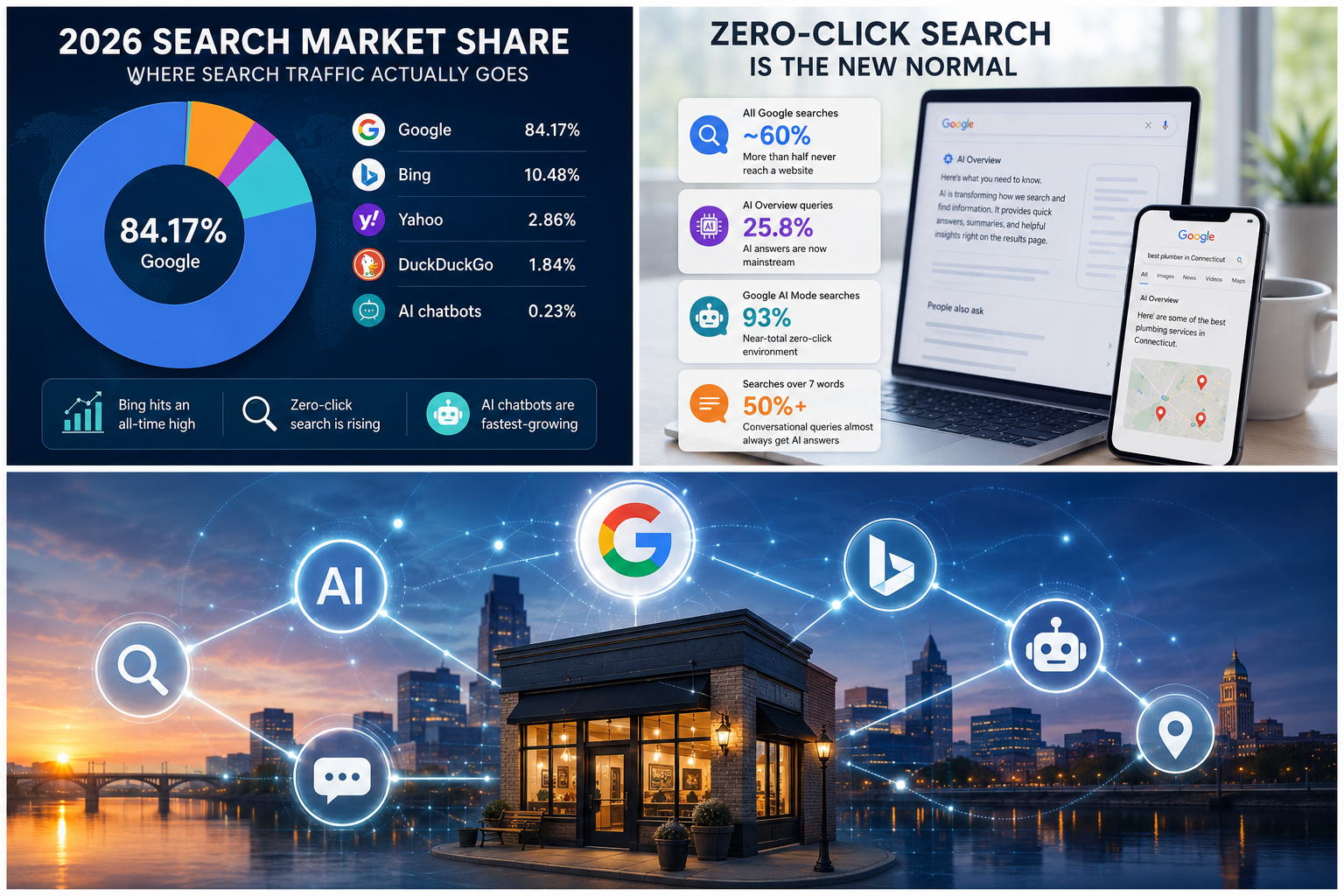
Here is where search traffic sits right now:
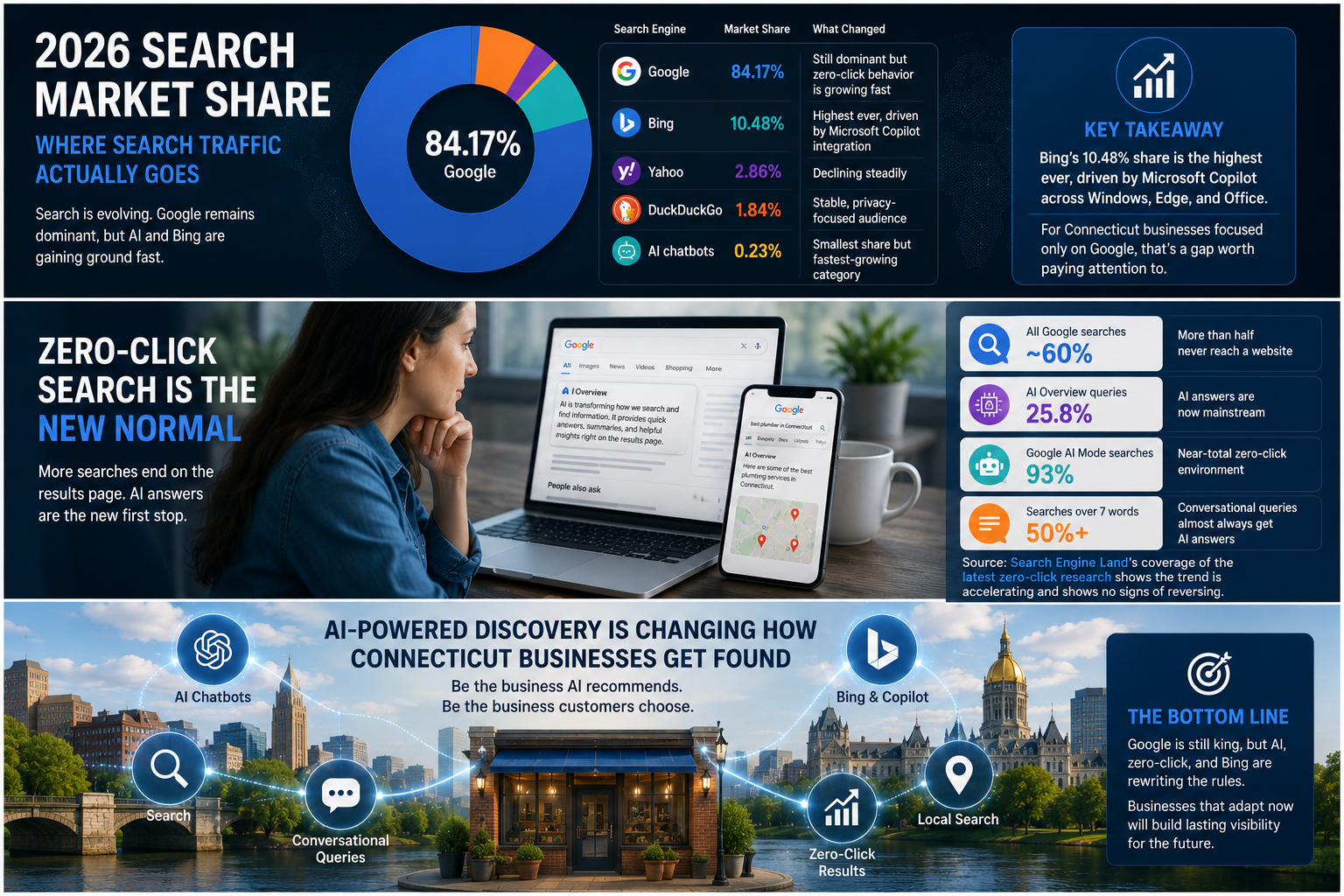
| Search Engine | Market Share | What Changed |
| 84.17% | Still dominant but zero-click behavior is growing fast | |
| Bing | 10.48% | Highest ever, driven by Microsoft Copilot integration |
| Yahoo | 2.86% | Declining steadily |
| DuckDuckGo | 1.84% | Stable, privacy-focused audience |
| AI chatbots | 0.23% | Smallest share but fastest-growing category |
The number that jumps out is Bing at 10.48%. That is the highest it has ever been. The reason is not that people suddenly started preferring Bing. It is that Microsoft has embedded Copilot directly into Windows, Edge, and Office. Every time someone uses a Microsoft product and asks a question, Bing is the engine behind the answer.
For Connecticut businesses that have been optimizing exclusively for Google, that is a gap worth paying attention to.
Zero-Click Search Is the New Normal
The search results page is no longer a doorway to your website. The numbers tell you why:
| Search Type | Zero Click Rate | What it means |
| All Google searches | ~60% | More than half never reach a website |
| AI Overview queries | 25.8% of all queries | AI answers are now mainstream |
| Google AI Mode searches | 93% | Near-total zero-click environment |
| Searches over 7 words | 50%+ trigger AI overviews | Conversational queries almost always get AI answers |
Search Engine Land’s coverage of the latest zero-click research puts it plainly: the trend is accelerating and shows no signs of reversing.
AI Chatbots Are Small But Growing Fastest
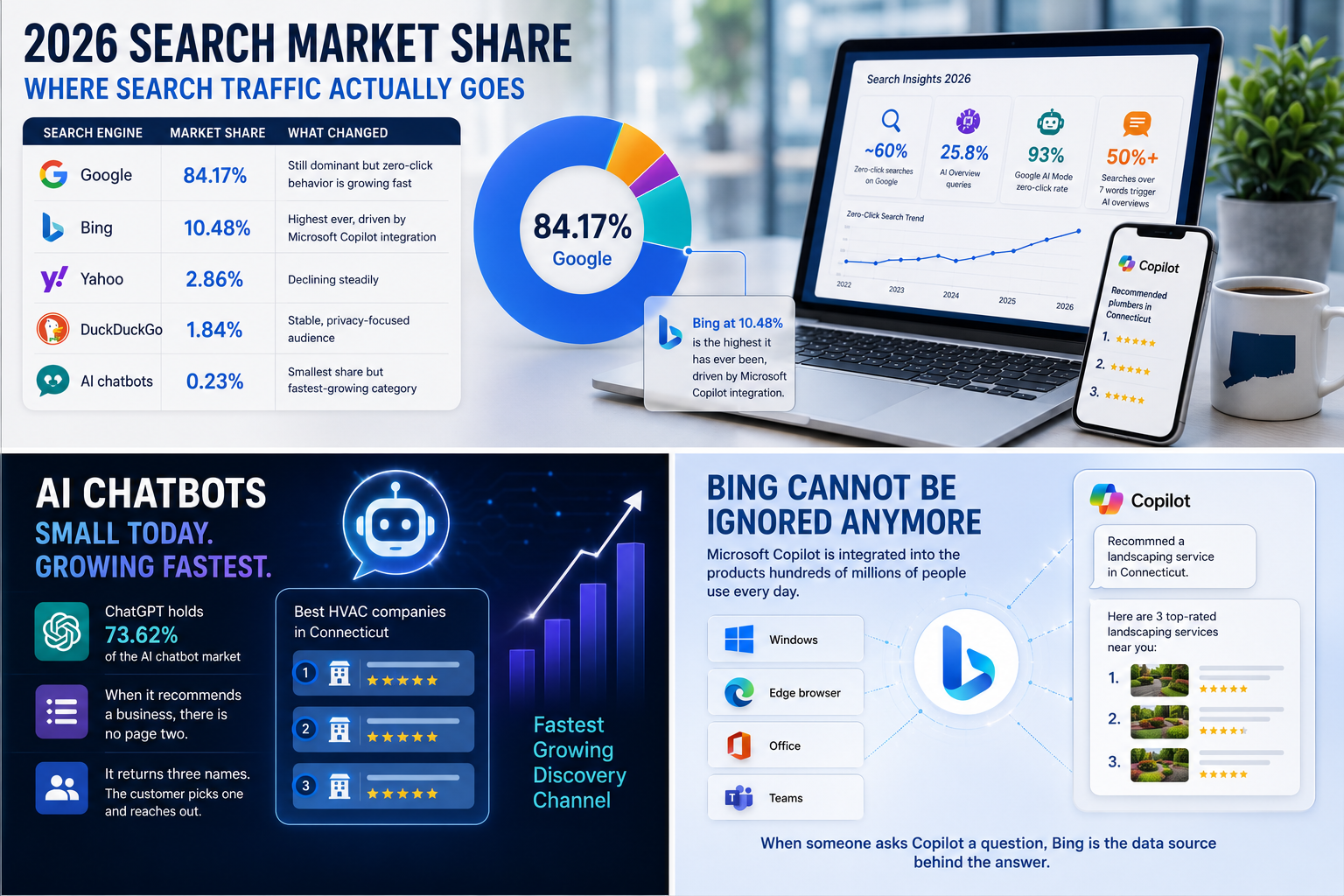
The AI chatbot category holds just 0.23% of total search referral traffic. That sounds insignificant. It is not.
It is the fastest growing discovery channel being tracked right now. A few things worth knowing about how it works:
- ChatGPT holds 73.62% of the AI chatbot market
- When it recommends a business, there is no page two
- It returns three names. The customer picks one and reaches out
Compare that to traditional Google Search, where a business on page two still gets some traffic, some visibility, and some chance. In AI recommendation search, if you are not in the three names, you do not exist for that query.
Bing Cannot Be Ignored Anymore
Bing at 10.48% is not just a statistic about a search engine. It is a signal about where AI-assisted search is going. Microsoft has integrated Copilot into the products that hundreds of millions of people use every day:
- Windows
- Edge browser
- Office and Teams
When someone types a question into the Edge address bar, Bing answers it. When someone asks Copilot to recommend a service in Connecticut, Bing is the data source. The good news is that optimizing for AI search does double duty. Everything that gets your business recommended by Google and ChatGPT works for Bing too.
What This Means for Connecticut Businesses
The 2026 search data points to three clear actions:
Stop Measuring Success by Keyword Rankings Alone
Rankings tell you where your page appears in a list. They do not tell you whether AI cited your business in an answer, whether a Copilot recommendation included your name, or whether a zero-click search resolved in your favor. Track AI share of voice alongside traditional rankings.
Optimize to Be the Cited Source, Not Just the Ranked Result
The businesses showing up in AI answers are not always the ones with the highest domain authority. They are the ones whose information is clear, consistent, and backed by real proof across the web. If you have not already worked through your Google Business Profile optimization, that is the place to start.
Do Not Ignore Bing
If your entire strategy is built around Google, you are missing a channel that now holds over 10% of U.S. search traffic and is growing because of AI integration. The optimization work is identical. The reach is additive.
The Bottom Line
The 2026 search landscape is not a crisis. It is a recalibration. Google is still dominant. Keyword rankings still matter. But the rules for what gets a business found, cited, and recommended have changed in ways that most CT businesses have not caught up with yet.
The businesses that understand this data and act on it now are going to build the same kind of durable advantage that early Google adopters built twenty years ago. The window is open. The data makes it clear which direction to move.
Want to Know Where You Stand?
Businesses we audit are often showing up very differently in AI search than they expect. Their traditional SEO looks solid. Their AI visibility tells a completely different story.
We are a Glastonbury-based digital marketing agency, and we have been helping Connecticut businesses get found online for 12 years. From website design and local SEO to social media and content creation, we build digital presences that actually work. Take a look at our portfolio or browse our case studies.